
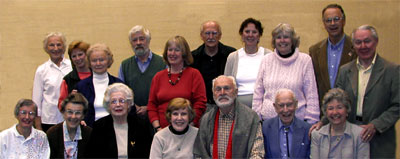
Past Presidents photo by Gerry Aspen in 2002
Santa Barbara is a haven and a heaven for artists, but the atmosphere that encouraged artists to do their best and a public to enjoy the results of that effort, didn’t happen overnight. At the turn of the last century in 1901, Alexander Harmer established a complex of studios that encouraged the artists and their public to interact. In the 1920s, the Santa Barbara School of Arts and the Santa Barbara Art Guild were established. During this time there was an influx of artists and an even greater need for exhibit space. This need was filled when at first, land was donated adjacent to the Public Library with the stipulation that it was to be used as the site of an art gallery, and then money was given by Mary Faulkner Gould to build the Faulkner Memorial Gallery which opened in 1930. Here, semiannual shows introduced the public not only to local artists, but also to notable out-of-town artists who were invited to participate. Then in 1933, a group of young artists banded together to show their works outdoors at De la Guerra Plaza and the Court House’s sunken garden. Hearing that the post office building at State and Anapamu streets was being abandoned for a new one, this band of artists obtained permission in 1937, to use the building as an indoor art gallery. This site proved so successful that by June of 1941, the Santa Barbara Museum of Art was opened.
Seems like a simple progression, an obvious agenda in a place so inspiring to artists, but an artist needs an audience and the evolution of finding and funding the space to exhibit wasn’t easy. It needed the involvement of the artists themselves. Although the Faulkner Gallery was opened with the intent of semiannual shows, this practice lasted only until the war years and then, because of necessity was abandoned. Despite the depression and the war, the number of artists in the area increased while exhibition space decreased. The Museum of Art had its permanent collection and an annual Tri-County Exhibition, and there were the private galleries such as the John Flynn or the Geddis Martin. But they accommodated very few of the growing number of artists. Also, the Museum had a change of heart or rather agenda. After the death of Donald Bear, Ala Story was chosen as the new director and, as her background was in international art, she shifted the emphasis from local artists to exhibits that had more of a national and international significance. This eliminated an essential display space for local artists. Spurred on by this lack, artists organized and in 1951 they circulated a petition to reopen the Faulkner as an exhibition space. During the 1930s and the war the Museum of Art had many shows and activities which overshadowed the Faulkner’s purpose. Perhaps being attached to a library has its drawbacks, but just as books should be free to the public so should the public have free access to art, the art of their community and the art of their fellow citizens. Credit should be given to the directors of the library, who, although supportive of the idea, knew it needed a guiding hand, and that it needed an organization of individuals to make it work.
Most organizations are founded by someone who, as the old Kaiser Permanente cement trucks put it, “find a need and fill it.” And our man of the hour was Douglass Parshall, who along with others founded the Santa Barbara Artists Group. On Saint Valentine’s day in 1952, about fifty artists gathered at Parshall’s Montecito home, and by accepting a constitution and by-laws established the Santa Barbara Art Association which satisfied the conditions as put forth by the Library Board. The first slate of officers were: Parshall as president, Joseph Knowles, vice president, Francois Martin, secretary, and Standish Backus, treasurer. William Hesthal, Forrest Hibbits, Lawrence Hinkley, Edward Nicholson, and William Dole comprised the membership committee. There was also an exhibition committee consisting of Clarence Hinkle, Renzo Fenci, Knowles, and Backus and this committee planned to stage three or four Faulkner exhibits a year.
On June 1, 1952, the Santa Barbara Art Association held its inaugural exhibition at the Faulkner Memorial Art Gallery. By that time, the initial membership had grown from fifty to eighty members. Today, the Santa Barbara Art Association has more than five hundred members.
In the preamble to the constitution, the founding fathers stated that “in presenting the artistic product of its members before the public, (the Association) must endeavor in all its dealings to distinguish good art from bad, sincere efforts from the false, substantial works from the vacuous.” To this end, each and every one of its members has to submit works to be juried in as a member and again to be selected for a show. The work is to be original and has to show merit.
But not only does the Association exist to exhibit the works of it members, it also is a part of the community. Three scholarships are awarded annually in the names of the first two presidents, Douglass Parshall and Wright Ludington, to deserving Fine Art students at the University of California at Santa Barbara, Santa Barbara City College, and Westmont College. The Association has contributed to the library’s art book section and presented art related lectures in the library. More recently, the SBAA has taken on a significant role in supporting young artists in the schools through its Student Art Fund (see link on home page). Although operated separately from the Association, Gallery 113 provides the membership the opportunity to exhibit and sell their works, and provides the public with shows that change monthly.
Over the years, members of the Association were responsible for launching the Santa Barbara Art Institute (now defunct) and especially supplying teaching staff to high schools, the city college, adult education, and UCSB. Murals at the Downtown Public Library, the old Von’s on Chapala Street, Santa Barbara National Bank, Cate School, and Westmont College along with the backgrounds for the bird and animal exhibits at the Natural History Museum have been made by members of the Association. The Santa Barbara Art Association can be proud of its accomplishments over the last fifty years and their artists with a vision … a vision that has resulted in an organization that has flourished and expanded in membership for sixty years. We remain an association of artists dedicated to the principles put forth by their founding fathers.
 Santa Barbara Art Association